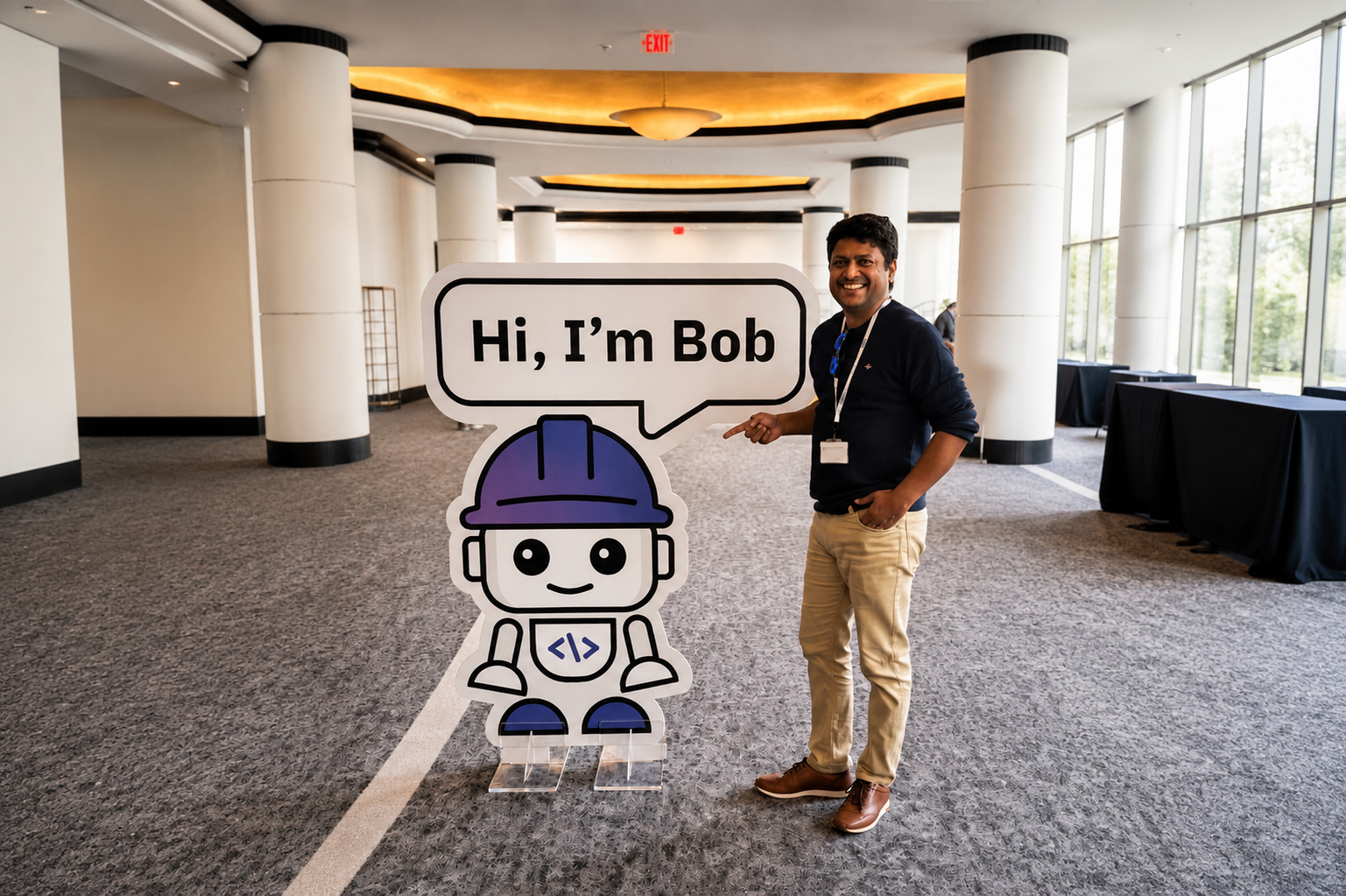
Meet my buddy, Bob – He’s unlike the rest!
Bob stands apart from many coding tools because it is built on IBM’s decades of experience serving some of the world’s largest enterprises, institutions and other highly regulated organisations. IBM Bob comes from a trusted technology partner – IBM, with over 100 years of experience, depth
5 Reasons why IBM Bob is different?
Let’s use Claude Code as an example.
Philosophy
At its core, the contrast here is between autonomy and governance. Claude Code is built to operate as an execution-driven partner—something that doesn’t wait to be micromanaged but instead takes initiative and moves work forward. It can read an entire codebase, generate and refine code, run tests, and even open pull requests, iterating until the job is done. The philosophy is deliberately frictionless: let the system handle the end-to-end execution so developers can stay focused on outcomes rather than process. This aligns with a broader shift toward AI doing most of the hands-on building, with humans stepping into orchestration roles. As a result, Claude Code is optimised for speed, developer productivity, and flow.
By contrast, IBM Bob takes a much more structured and governed approach. It is designed around clear separation of planning, execution, and validation, with built-in checkpoints and approvals at each stage. Rather than “just doing,” it emphasises doing things the right way—embedding enterprise guardrails such as security, compliance, and auditability throughout the lifecycle. In this sense, Bob acts as an AI-powered SDLC partner, coordinating planning, execution, and verification rather than collapsing them into a single autonomous loop. The trade-off is intentional: Bob prioritises safety, predictability, and enterprise compliance, making it better suited to environments where control and accountability matter as much as speed.
Interaction Model
The difference in operating model between Claude Code and IBM Bob further reinforces the broader theme of autonomy versus governance. Claude Code is fundamentally agent-first: You describe an outcome—“fix failing tests,” for example—and it takes over from there, debugging, editing, rerunning, and committing changes in a continuous loop until the issue is resolved. It can even spawn sub-agents and orchestrate workflows, extending its reach across tasks and pipelines such as CI/CD. The defining characteristic here is uninterrupted execution: once given intent, it maintains momentum and drives work forward autonomously, minimising the need for human intervention.
IBM Bob, on the other hand, introduces a much more structured and deliberate interaction model through clearly defined “agentic modes.” Users explicitly move between stages such as Ask (to understand the problem), Plan (to design the architecture), Code (to implement), and Orchestrate (to coordinate workflows). This enforces a disciplined progression—think, design, build, and validate—rather than collapsing everything into a single execution loop. The key distinction is intentionality: Bob requires clarity and alignment upfront before execution begins, ensuring that decisions are considered, traceable, and governed. While this may introduce more upfront structure, it provides stronger control, consistency, and reliability, particularly in enterprise environments where oversight is critical.
Coding Tool vs SDLC Platform
The distinction also becomes clear when you look at where each system places its centre of gravity. Claude Code is, at its core, a coding agent and workflow executor. Its focus is tightly aligned to the act of software development itself—generating code, debugging issues, running tests, and managing Git workflows. While it can span tools like the IDE or terminal, everything ultimately revolves around the coding task. It is designed to stay close to the developer’s immediate problem and accelerate execution within that context, reinforcing its role as a hands-on, high-velocity “doer.”
IBM Bob, by contrast, is positioned not as a coding assistant but as a full SDLC orchestration layer. Its scope deliberately spans the entire software lifecycle—from planning and coding to refactoring, security checks, compliance validation, and even modernisation initiatives. Rather than centring purely on code, it aims to reshape how software is conceived, built, and governed end-to-end. In that sense, Bob operates more like an AI-native fusion of DevOps platform and architecture assistant, coordinating activities across stages rather than optimising a single step. The shift is subtle but important: Claude Code zooms in on execution at the code level, while IBM Bob zooms out to orchestrate the delivery system itself.
Model Strategy
The underlying model strategy is another area where the philosophies of Claude Code and IBM Bob diverge quite sharply. Claude Code is built around Anthropic’s own models—such as Opus and Sonnet—and is tightly optimised to maximise model capability while maintaining autonomy. The idea is to push a highly capable model to operate end-to-end with minimal switching or external decision-making, allowing it to maintain context and momentum as it executes tasks. This reinforces its role as a self-directed agent: intelligence and execution are closely coupled, enabling fast, fluid problem-solving without much overhead.
IBM Bob, in contrast, takes a more modular and governed approach through multi-model orchestration. Rather than relying on a single model, it dynamically selects from IBM Granite and other models depending on the specific task at hand. This selection is deliberate, taking into account factors such as cost, risk, and contextual requirements. The result is a system that treats models as interchangeable components within a controlled architecture, rather than a single all-purpose engine. This approach enables tighter cost management, greater predictability, and stronger governance—ensuring that the right level of capability is applied to the right problem, without overexposure or unnecessary spend.
Where Each Wins
The differences in philosophy also become most visible when you look at where each approach performs best. Claude Code tends to excel in environments where speed matters more than process—particularly in greenfield development, startups, or microservices-based architectures where there’s less legacy to untangle and fewer constraints to manage. In these scenarios, the ability to move quickly, trust automation, and iterate fast is a clear advantage. Claude Code thrives when the goal is momentum—rapidly turning ideas into working software with minimal overhead. It embodies a “get it done fast” mindset, where progress and productivity take precedence over formal structure.
IBM Bob, by contrast, comes into its own in more complex, high-stakes environments. When organisations are dealing with legacy estates, regulated systems, or large-scale modernisation efforts, the need shifts from speed to control. Here, Bob’s emphasis on governance, traceability, and structured execution becomes critical. It ensures that changes are deliberate, auditable, and aligned with enterprise standards at every step. Rather than optimising for raw velocity, it optimises for confidence and accountability—making it far better suited to transformations where the cost of error is high. In that sense, Bob represents a “get it done right—and make sure it’s auditable” philosophy, prioritising robustness over rapid iteration.
In summary, Claude Code executes; IBM Bob architects—speed and autonomy versus governance, planning, and enterprise control.
More info:
It’s worth visiting these URL’s if you want more info.